
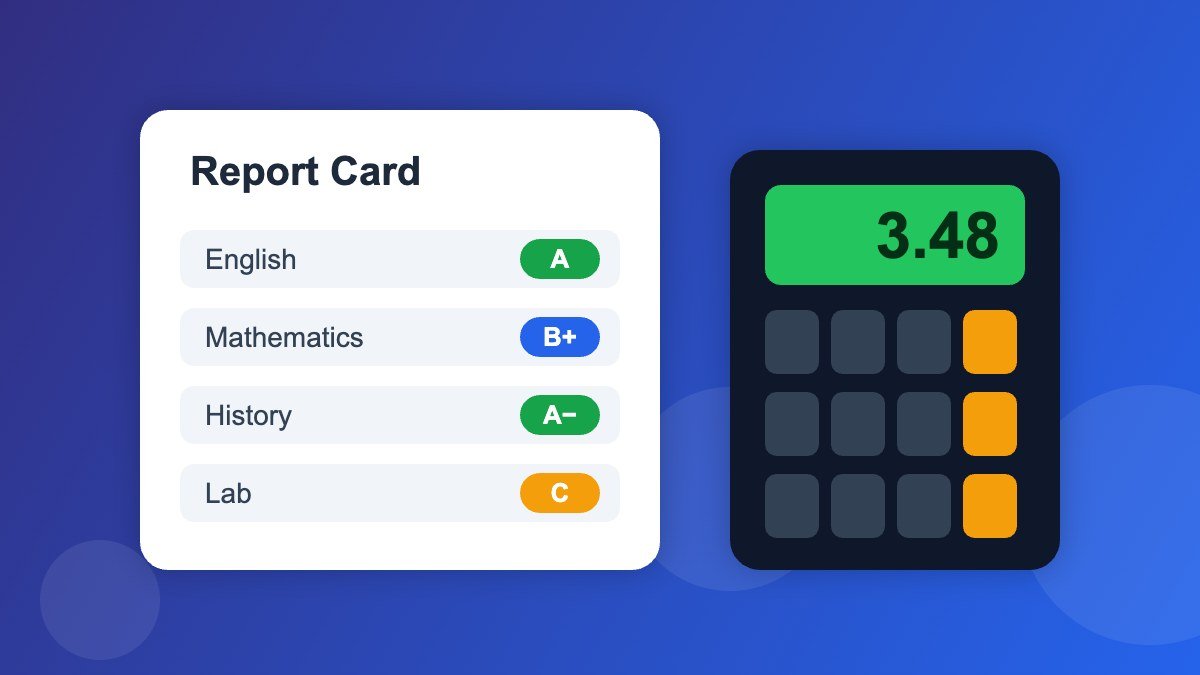
A GPA on the 4.0 scale is a credit-weighted average of your grade points. Once you know the points for each letter grade, the calculation takes four steps, and the same method also gives you a cumulative GPA across semesters. The GPA Calculator does the arithmetic for you, but it helps to know what it is doing.
The standard 4.0 GPA scale
Most U.S. colleges and many high schools use these grade points. Each school sets its own percentage cut-offs for each letter, so check your institution's grading policy for those.
| Letter grade | Grade points |
|---|---|
| A+ / A | 4.0 |
| A− | 3.7 |
| B+ | 3.3 |
| B | 3.0 |
| B− | 2.7 |
| C+ | 2.3 |
| C | 2.0 |
| C− | 1.7 |
| D+ | 1.3 |
| D | 1.0 |
| F | 0.0 |
Some schools give an A+ 4.3 instead of 4.0. If yours does, use your school's value.
How to calculate GPA step by step
- Convert each grade to points using the table above.
- Multiply by the course credits to get quality points. A B+ (3.3) in a 4-credit course is 3.3 × 4 = 13.2 quality points.
- Add up all the quality points and all the credits.
- Divide total quality points by total credits.
GPA = total quality points ÷ total credits
Worked example
| Course | Grade | Credits | Quality points |
|---|---|---|---|
| English | A (4.0) | 3 | 12.0 |
| Mathematics | B+ (3.3) | 4 | 13.2 |
| History | A− (3.7) | 3 | 11.1 |
| Lab | C (2.0) | 1 | 2.0 |
| Total | 11 | 38.3 |
38.3 ÷ 11 = 3.48. Notice that the 4-credit B+ pulls the result down more than the 1-credit C does, because credits act as weights.
How to calculate cumulative GPA
Do not average your semester GPAs. Add the quality points and credits from every semester, then divide once. If semester 1 is 38.3 points over 11 credits (3.48) and semester 2 is 57.0 points over 15 credits (3.80), your cumulative GPA is (38.3 + 57.0) ÷ (11 + 15) = 95.3 ÷ 26 = 3.67. A simple average of 3.48 and 3.80 would give 3.64, which is wrong because the second semester had more credits.
Weighted vs unweighted GPA
An unweighted GPA uses the 0–4.0 scale for every class. Many high schools also report a weighted GPA that adds extra points for harder classes, often +0.5 for honors and +1.0 for AP or IB, so an A in an AP class can count as 5.0. Weighting rules differ between schools, and colleges often recalculate GPAs their own way, so always say which kind of GPA you are reporting.
Converting Indian CGPA or percentage to a 4.0 GPA
There is no single official formula. Dividing a 10-point CGPA by 10 and multiplying by 4 (so 8.0 becomes 3.2) is only a rough estimate. Credential evaluators such as WES convert your marks course by course, and the WES iGPA Calculator is designed to give an estimate of that. If a university asks for a percentage instead, use your university's own rule; the CGPA to Percentage Calculator includes the formulas for CBSE, VTU, Mumbai University, KTU and others.
Common mistakes
- Averaging grade points without weighting them by credits.
- Averaging semester GPAs instead of combining quality points.
- Including pass/fail or withdrawn courses that your school leaves out of the GPA.
- Mixing weighted and unweighted values in the same calculation.
Frequently asked questions
Is a 3.5 GPA good?
On a 4.0 scale, 3.5 means you are averaging between a B+ and an A−. Whether it is "good" depends on the programme you are applying to, so compare it with that programme's published admission averages.
How many credits does a course usually have?
Most college courses are 3 or 4 credits, and labs are often 1. Use the credit value printed on your transcript.
Can I raise my GPA quickly?
The more credits you have already completed, the less one semester can move your cumulative GPA. Courses with more credits have the biggest effect, which you can test in the GPA Calculator by adding next semester's expected grades.